As Australia heads into a hotter spring, mine sites may need to think differently about dust, water use and the way exposed surfaces are managed.
El Niño is firmly established in the Pacific and continuing to strengthen.
As of 1 September 2026, the Bureau of Meteorology reported conditions consistent with a strong El Niño, with further intensification likely through spring. Current modelling suggests the event may peak in late spring or summer.
You may hear events of this strength described as a “Super El Niño”, but that is not an official Bureau classification. And a strong El Niño does not automatically mean extreme dry conditions everywhere.
Australia’s climate is influenced by several systems at once.
What matters for mine operators is the actual seasonal outlook.
For September to November, the Bureau is forecasting above-average daytime temperatures across much of Australia south of the tropics, with below-average rainfall more likely across parts of the south and east. Other areas, particularly in western Australia, may see above-average rainfall.
So the question is not whether every mine will experience the same conditions. It is:
If your site becomes hotter and drier, is your dust-control program ready for it?
When the ground dries faster, dust control has to work harder
On an unsealed mine site, moisture plays an important role in keeping fine particles on the ground.
As surfaces dry, traffic, wind and day-to-day operations can disturb those fines more easily.
For haul roads, that can mean:
- increased dust lift under heavy vehicle movements
- reduced visibility
- more frequent water-cart passes
- greater demand on available water
- additional road-maintenance activity
Water remains an important part of dust management, but water alone provides temporary control. In hot and dry conditions, repeatedly wetting the same road can quickly become a cycle.

The opportunity is not necessarily to stop using water. It is to make the water being used work harder and last longer.
Active haul roads need a different approach
High-traffic haul roads have to manage far more than loose dust.
Any treatment also has to perform under repeated heavy vehicle movements while maintaining the road conditions operators depend on.
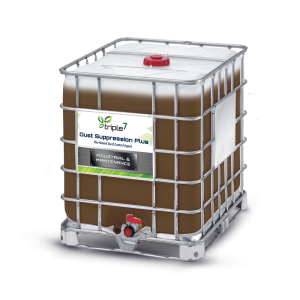
Dust Suppression Plus is designed for long-term dust suppression on unsealed roads and work sites. Its bio-based formulation helps bind fine particles and hold them in place, including under heavy traffic and changing weather conditions.
For sites already using water carts, it can be incorporated into the existing dust-control program rather than requiring an entirely different application method.
And we have already seen what that shift can mean in practice.
At one large mining operation, moving beyond water-only suppression across an extensive haul-road network reduced the site’s reliance on repeated watering and road maintenance while maintaining dust control under heavy traffic, heat and dry conditions.
[Read the full haul-road case study →]
The important point is not another percentage.
It is the change in approach: from repeatedly wetting the road to actively managing the surface.
Not every dusty area is a haul road
One of the easiest mistakes in site-wide dust management is treating every surface the same way.
A mine can contain very different dust-generating areas:
- High traffic
Haul roads and access roads that are constantly disturbed. - Large exposed surfaces
Open ground, laydown areas and other surfaces where wind or site activity can lift fines. - Temporary or low-traffic areas
Inactive zones, temporary work areas and surfaces that need control without the demands of constant heavy traffic.
Each presents a different problem.
And that means the best solution may not always be the same product.

For larger exposed areas, stop the surface from becoming the source
Some dust problems are less about vehicle movement and more about the amount of exposed ground.
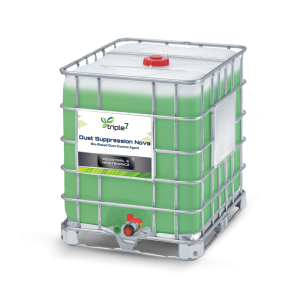
This is where Dust Suppression Nova can provide a different type of control.
Rather than treating a constantly trafficked haul road, Nova can be used where a more durable treatment is required across larger exposed surfaces.
A recent application demonstrated this across a 6-hectare site, where Dust Suppression Nova Green was applied using a water cart. The treatment provided consistent visible coverage and maintained surface integrity despite substantial material and vehicle movement across the area.
The value here is straightforward:
If a large surface is likely to generate dust, manage the surface before the dust becomes airborne.
El Niño is a reason to review the plan, not panic
A strengthening El Niño does not mean every Australian mine should expect drought.
The Bureau’s current outlook makes that clear: rainfall forecasts vary significantly by region, even while warmer daytime temperatures are expected across much of the country south of the tropics.
But for sites entering a hotter or drier period, now is a useful time to ask:
- Where does most of our dust come from?
- How often are water carts returning to the same surfaces?
- Are we using the same treatment across areas with completely different traffic and exposure?
- Could exposed surfaces be stabilised before they become an ongoing dust problem?
The answer will be different for every operation. The goal is not simply to apply more product or more water. It is to match the control method to the ground, traffic and conditions in front of you. Because when the weather gets hotter and the ground gets drier, the best dust-control strategy is one that does not have to start again every time the surface dries out.
Preparing your site for hotter, drier conditions? Talk to our team about a dust-control approach suited to your roads, exposed areas and operating conditions.